Yesterday was a true selling day for the market, with all of the averages down at least 1.5%. The reasons for the decline are of no matter. It is simply a warning shot that the market is due for a correction. I found it interesting that the futures pointed to a rebound early this morning, but slowly declined into the open, and now the market is down as I write this about 11 am. If there is follow through today, then yesterday's action suggests a correction is at hand. If another true selling day occurs within the next week, then the easier money will likely be made on the short side. For now, it is a good idea to consider both long and short trades when daytrading to hedge your bets.
Scott Cole
www.bestdaytradingstocks.com
Wednesday, February 23, 2011

Thursday, January 20, 2011
Stock Market Commentary
Yesterday's trading action suggests a short term top may now be in place for the market. With the exception of the Dow Jones Industrials, all of the major averages were down at least 1%. Also, yesterday's close was below the previous four closes. When that occurs the day after a new high is made, odds are that a top is in place in the near term.
Daytraders should pay attention to a potential change in character for this market. While yesterday is just one trading day, if it's action is not reversed in the next few days, then the market is likely heading for a bit of a correction. As a result, the best opportunities will involve short positions or long positions within ETFs that short the market.
Scott Cole
www.bestdaytradingstocks.com
Daytraders should pay attention to a potential change in character for this market. While yesterday is just one trading day, if it's action is not reversed in the next few days, then the market is likely heading for a bit of a correction. As a result, the best opportunities will involve short positions or long positions within ETFs that short the market.
Scott Cole
www.bestdaytradingstocks.com
Sunday, January 9, 2011
Weekly Stock Market Commentary
U.S. Stocks continued their march upward this week as the S&P 500 closed with a 1.1% gain on the week. Historically, as far as records have been kept, a 1% up move in the first week of the year has a 100% correlation to the market ending the year with a gain. This is according to CNBC. Of course, this is utterly worthless information. However, since this is also the third year in the presidential cycle, odds are in favor of a positive year as well.
In any event, all this suggests is that the current trend is up, and for daytraders, it makes most sense to stay on the side of the trend. I've seen over and over again in recent weeks how the market opens lower and closes higher than the open. Even if it is just a small gain or a small loss, the short sellers are getting grinded to death. At some point there will be a correction, however, at this point, it is not yet on the horizon.
One of the big trades on Friday was RBN. This is the kind of move that many daytraders miss. The stock gapped significantly at the open, and many daytraders simply like to fade this kind of gap. However, a more experienced trader would look at the daily chart and see a favorable set up for a big up move.
After the stock gapped higher, it moved significantly in the first five minutes. It is virtually impossible to try and scalp such a move. In fact, it would be foolish, because you would be leaving a lot on the table. Better daytraders and short term traders would look for a bigger move.
Based on our strategy, an entry point would have been somewhere just under $40. The stock closed at $41.18. The chart is below
Scott Cole
www.bestdaytradingstocks.com

In any event, all this suggests is that the current trend is up, and for daytraders, it makes most sense to stay on the side of the trend. I've seen over and over again in recent weeks how the market opens lower and closes higher than the open. Even if it is just a small gain or a small loss, the short sellers are getting grinded to death. At some point there will be a correction, however, at this point, it is not yet on the horizon.
One of the big trades on Friday was RBN. This is the kind of move that many daytraders miss. The stock gapped significantly at the open, and many daytraders simply like to fade this kind of gap. However, a more experienced trader would look at the daily chart and see a favorable set up for a big up move.
After the stock gapped higher, it moved significantly in the first five minutes. It is virtually impossible to try and scalp such a move. In fact, it would be foolish, because you would be leaving a lot on the table. Better daytraders and short term traders would look for a bigger move.
Based on our strategy, an entry point would have been somewhere just under $40. The stock closed at $41.18. The chart is below
Scott Cole
www.bestdaytradingstocks.com

Monday, July 12, 2010
Stocks Trade Modestly Higher in Sluggish Trade
U.S. Stocks closed with modest gains in light trade on Monday as trading shifts to earnings reports. With little economic news over the weekend and during trading today, stocks traded within a narrow trading range, and it appears the market may have tired out a bit after last week's big gains.
Among the big industry performers today were semiconductors, music and video stores, lumber and auto makers.
Low priced stocks were again among the big percentage movers of the day. The exception was Hewitt (HEW) which was up 32% on reports that Aon put in a bid to buy the company. Playboy stock was a big winner today as well. Otherwise, most stocks we look at for daytrading did not move much today. Given that the market has traded up for five consecutive sessions and that the overall trend is still down, we should see some decent daytrades involving short selling over the next couple days.
Scott Cole
www.bestdaytradingstocks.com
Among the big industry performers today were semiconductors, music and video stores, lumber and auto makers.
Low priced stocks were again among the big percentage movers of the day. The exception was Hewitt (HEW) which was up 32% on reports that Aon put in a bid to buy the company. Playboy stock was a big winner today as well. Otherwise, most stocks we look at for daytrading did not move much today. Given that the market has traded up for five consecutive sessions and that the overall trend is still down, we should see some decent daytrades involving short selling over the next couple days.
Scott Cole
www.bestdaytradingstocks.com
Wednesday, July 7, 2010
Stocks Explode to the Upside
U.S. Stocks posted very strong gains today, with no particular reason for the move. Volume was slightly ahead of yesterday, and therefore I give this move some credibility. Stocks rose about 3% across the board today in the major market averages.
Stock index futures were initially suggesting a lower open, but as the market progressed, leading up to the open, they picked up some steam, and the train seemed to gain significant momentum throughout the day. This is the kind of trading day that suggests the possibility of a change in character for the market.
A check of the leading industry groups today indicates that real estate was the big winner on the day. Five of the top twenty groups were real estate related. Other strong performers included banks, technology and casinos.
Going forward, the market still has a big hill to climb to negate the recent downside breakout completely. If the market can push to a close above 1131 on the S&P, then you have a head and shoulders continuation pattern, which is bullish. Ultimately though, I still see a trading range market, but the range just got a bit wider.
Retail sales will be reported tomorrow for June, and that could put a damper on the market. An upside surprise will add to today's momentum.
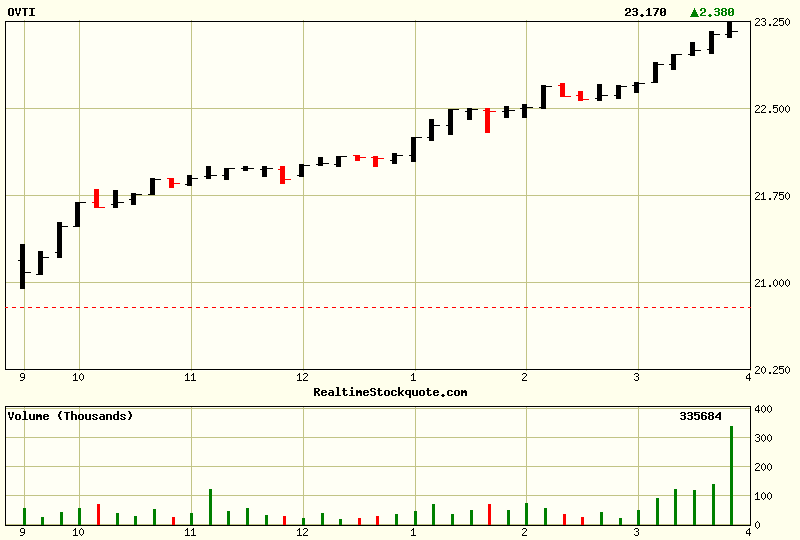
For daytraders, the pickins could not have been easier. Opening range breakout systems worked beautifully during this move to the upside, since there was not a major upside gap in the major averages. The single best stock from the standpoint of its move for the day, and its volume was Omnivision Technologies. It rose over 11% on the day, and is a nice liquid stock. Check out the chart below.

Scott Cole
www.bestdaytradingstocks.com
Stock index futures were initially suggesting a lower open, but as the market progressed, leading up to the open, they picked up some steam, and the train seemed to gain significant momentum throughout the day. This is the kind of trading day that suggests the possibility of a change in character for the market.
A check of the leading industry groups today indicates that real estate was the big winner on the day. Five of the top twenty groups were real estate related. Other strong performers included banks, technology and casinos.
Going forward, the market still has a big hill to climb to negate the recent downside breakout completely. If the market can push to a close above 1131 on the S&P, then you have a head and shoulders continuation pattern, which is bullish. Ultimately though, I still see a trading range market, but the range just got a bit wider.
Retail sales will be reported tomorrow for June, and that could put a damper on the market. An upside surprise will add to today's momentum.
For daytraders, the pickins could not have been easier. Opening range breakout systems worked beautifully during this move to the upside, since there was not a major upside gap in the major averages. The single best stock from the standpoint of its move for the day, and its volume was Omnivision Technologies. It rose over 11% on the day, and is a nice liquid stock. Check out the chart below.
Scott Cole
www.bestdaytradingstocks.com
Tuesday, June 29, 2010
Daytrading Stocks in a Bear Market
Since the stock market has traded significantly downward over the last month, it appears that another bear market may be underway. While the prevailing Wall Street definition of a bear market is a 20% drop below recent highs, the average bear market tends to drop quite a bit more than that. As of this writing, the S&P 500 has dropped over 14% below its April 23 closing high of 1217.
Daytrading stocks during market declines can prove to be quite the challenge for day traders no matter how much experience they have. This is due to the fact that market volatility has a tendency to increase during most market declines, whether they are short term corrections or the typical bear market. This increase in volatility can wipe out the trading capital of even the experienced trader if they do not adjust their trading.
Generally speaking, after large run-ups in stock prices, or in any market, there will be violent pull-backs. While this increase in volatility can produce some big directional moves, there may be sizable intraday swings that can catch a trader off guard.
So, how does a daytrader prepare for these conditions? Well, most daytraders are not in the business of forecasting market direction, but it can be very helpful to pay attention to some technical and psychological indicators that may provide a clue regarding market direction. Those indicators include price and volume, the TRIN, New 52 week highs and lows, the advance/decline line, the number of bullish vs. bearish investors, etc. A more detailed discussion regarding these indicators is more suitable for another article.
When a daytrader becomes aware that the market character has changed to a bearish tone, then it is time to adjust their thinking when it comes to managing trades. First of all, due to the usual increase in market volatility, the trader should scale back position size. While it may have been reasonable to trade 1,000 shares in a stock during a bull move, 500 shares might be more reasonable in a bear move. The novice trader will think that they are giving up a significant profit opportunity by trading smaller during these sharp down moves. The experienced trader realizes that it is more important to preserve capital for time periods when the market is more predictable and less volatile.
One other issue facing daytraders during these bear markets is that the market has a tendency to have sharp intraday reversals, and there tends to be more sizable opening gaps. As some daytraders actually do carry positions over night, it is a good idea to carry smaller positions over night due to the greater risk of a market reversal.
The daytrader should also be aware that the overall long term market tendency is for stocks to trade higher each day. Therefore, even when the market is in a downtrend, a great many trading days will actually have a tendency to close to the upside. During the current down move, nearly 40% of the trading days have closed to the upside. If a daytrader can recognize that even bear markets will pause for a breather, they will recognize significant opportunities to profit after these brief pauses when the market resumes its downtrend.
Daytraders should also consider trading other vehicles besides individual stocks during bear markets. This is due to the fact that it costs the trader extra to short a stock, since they must first borrow the shares from their broker, and pay interest on those shares, in order to sell the stock short. Therefore, daytraders should consider trading stock index futures, or ETFs that rise when the market falls. It is important that traders consider the cost of their trades, not just whether they make a profit or loss.
While it is definitely possible to trade profitably during bear markets, there are significant pitfalls. For many novice daytraders, it may just be a good idea to sit on the sidelines and observe the market action so that they are prepared for the next bear market downturn when it comes along.
Scott Cole
www.bestdaytradingstocks.com
Daytrading stocks during market declines can prove to be quite the challenge for day traders no matter how much experience they have. This is due to the fact that market volatility has a tendency to increase during most market declines, whether they are short term corrections or the typical bear market. This increase in volatility can wipe out the trading capital of even the experienced trader if they do not adjust their trading.
Generally speaking, after large run-ups in stock prices, or in any market, there will be violent pull-backs. While this increase in volatility can produce some big directional moves, there may be sizable intraday swings that can catch a trader off guard.
So, how does a daytrader prepare for these conditions? Well, most daytraders are not in the business of forecasting market direction, but it can be very helpful to pay attention to some technical and psychological indicators that may provide a clue regarding market direction. Those indicators include price and volume, the TRIN, New 52 week highs and lows, the advance/decline line, the number of bullish vs. bearish investors, etc. A more detailed discussion regarding these indicators is more suitable for another article.
When a daytrader becomes aware that the market character has changed to a bearish tone, then it is time to adjust their thinking when it comes to managing trades. First of all, due to the usual increase in market volatility, the trader should scale back position size. While it may have been reasonable to trade 1,000 shares in a stock during a bull move, 500 shares might be more reasonable in a bear move. The novice trader will think that they are giving up a significant profit opportunity by trading smaller during these sharp down moves. The experienced trader realizes that it is more important to preserve capital for time periods when the market is more predictable and less volatile.
One other issue facing daytraders during these bear markets is that the market has a tendency to have sharp intraday reversals, and there tends to be more sizable opening gaps. As some daytraders actually do carry positions over night, it is a good idea to carry smaller positions over night due to the greater risk of a market reversal.
The daytrader should also be aware that the overall long term market tendency is for stocks to trade higher each day. Therefore, even when the market is in a downtrend, a great many trading days will actually have a tendency to close to the upside. During the current down move, nearly 40% of the trading days have closed to the upside. If a daytrader can recognize that even bear markets will pause for a breather, they will recognize significant opportunities to profit after these brief pauses when the market resumes its downtrend.
Daytraders should also consider trading other vehicles besides individual stocks during bear markets. This is due to the fact that it costs the trader extra to short a stock, since they must first borrow the shares from their broker, and pay interest on those shares, in order to sell the stock short. Therefore, daytraders should consider trading stock index futures, or ETFs that rise when the market falls. It is important that traders consider the cost of their trades, not just whether they make a profit or loss.
While it is definitely possible to trade profitably during bear markets, there are significant pitfalls. For many novice daytraders, it may just be a good idea to sit on the sidelines and observe the market action so that they are prepared for the next bear market downturn when it comes along.
Scott Cole
www.bestdaytradingstocks.com
Stocks Get Hammered as Economic Worries Mount
U.S. Stocks fell sharply today as traders worried about the prospects of a double dip recession. The major averages closed anywhere from down 2.65% for the Dow Industrials to over 4% for the Dow Transports. Tech stocks really took it on the chin. The charts for the S&P 500 and Nasdaq averages look quite ominous, with large breakaway gaps appearing, and the lows of the day penetrating the June and February lows on the S&P 500. In fact, the S&P closed at its lowest level since last November.
This says to me that we have broken out to the downside. In all the other cases where the S&P tested the 1040 area this year, it actually closed above 1060 each time. Today, it closed at 1041 after trading as low as 1035. As such, the neckline is broken in my view, and the next major support area is 950. The only thing that can turn this around is a major upside surprise in the jobs data this week. If it comes in weak, look out below.
Scott Cole
www.bestdaytradingstocks.com
This says to me that we have broken out to the downside. In all the other cases where the S&P tested the 1040 area this year, it actually closed above 1060 each time. Today, it closed at 1041 after trading as low as 1035. As such, the neckline is broken in my view, and the next major support area is 950. The only thing that can turn this around is a major upside surprise in the jobs data this week. If it comes in weak, look out below.
Scott Cole
www.bestdaytradingstocks.com
Subscribe to:
Posts (Atom)